
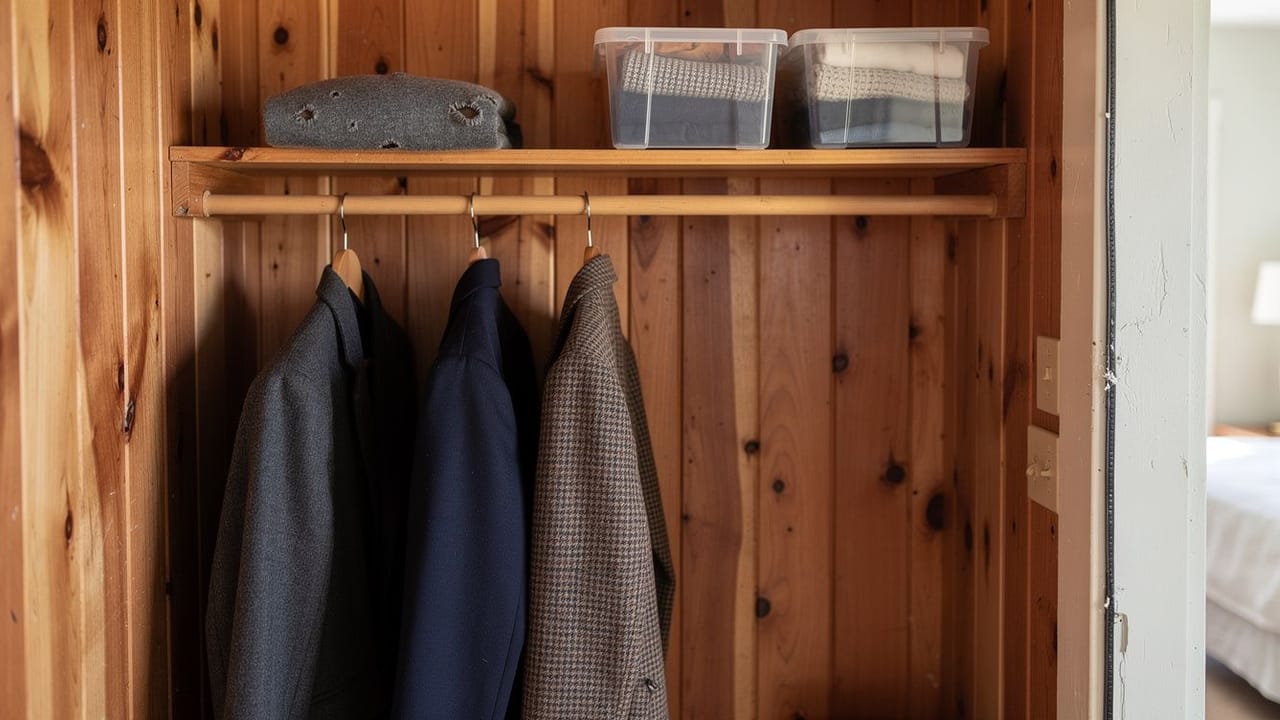
· by Michael Blair, Nashville's Closets
A cedar closet has long been the traditional answer to clothes moths, and plenty of older houses around Nashville still have one, or a cedar chest up in the attic. The idea has something to it. According to UC IPM’s pest note on clothes moths, the oil in aromatic eastern red cedar can kill small larvae, though it does not affect large ones, and the wood loses that quality after several years. The same note calls the effectiveness of cedar chests and cedar closet floors debatable, and the insect doing the damage may not be a moth at all. So we treat cedar as a pleasant lining and put the real protection into how the clothes are cleaned, stored and checked.
Who is eating the sweater
Clothes moths are easy to miss. UC IPM describes the common webbing clothes moth as gold, about a quarter inch long at rest, and a weak flyer that is not drawn to lights, so it tends to stay near the infested clothes in a dark corner of the closet. The moths you see fluttering around the kitchen are usually food- and grain-infesting moths, roughly twice that length, which go after the pantry and leave your wool alone. The damage is done by the larvae, which feed on wool, fur, feathers and other animal fibers, and the note says fabrics with food, perspiration or urine stains are more subject to damage. Look under collars and cuffs, where it usually hides, for holes, patches of silk webbing, or small silken cases that take on the color of the fabric.
Carpet beetles do the same kind of damage, and UC IPM’s carpet beetle pest note says it is not always possible to tell from the damage which of the two caused it. The adults feed on pollen and nectar outdoors, on plants such as crape myrtle, and fly in through open windows and doors; the varied carpet beetle usually turns up in spring or early summer, often on a windowsill. Their larvae are small and covered in dense tufts of hair, and they eat wool, silk, leather, fur and feathers as well as lint, pet hair and dead insects. They spin no webbing, so holes with brown, bristly shed skins nearby and no web point to carpet beetles, and they tend to eat a larger patch in one place where moths leave scattered holes. Cedar is no answer for them either: the same note calls cedar chests not reliable or effective at repelling pests.
Does cedar actually kill clothes moths?
Fresh aromatic cedar has an oil that can kill small larvae, and that is about the extent of it. UC IPM’s clothes moth note says it does not affect large larvae and that cedar loses even this after several years, and neither UC note says it stops adult moths from laying eggs. What the note does say is that a tightly constructed chest is more important in the long run than the type of wood it is made from. A closet that gets opened every morning and leaks air under the door is a long way from a tight chest. Light sanding is the usual advice for bringing the smell back; we have not seen a published test showing it brings back any protection, so we do not sell it as one.
What a well-built cedar closet does give you is a closed, tight space with a pleasant smell, and the tightness is the useful part. Think of it as a well-sealed closet with a nice lining, and protect the clothes inside it the same way you would in any other closet.
How do you protect wool clothes from moths?
Clean before storing. Both UC notes say food and perspiration residue draws these insects, and Purdue Extension’s guide to clothes moths and carpet beetles says never to store soiled garments, so a sweater put away with a season of wear on it is the one that gets eaten. UC IPM’s clothes moth note gives laundering for 20 to 30 minutes in water of at least 120°F as the way to kill every stage; many woolens cannot take water that hot, and for those it says a dry cleaner may be the only suitable option, which the carpet beetle note also lists as killing all stages. Then seal it. The storage advice in both notes is a clean, pest-free item in an airtight container or a sealed plastic bag, so a bin with a tight lid does the job, while an open shelf or a breathable cotton bag, which keeps dust off but is not airtight, does not. We only pack clothes that are fully dry, and our post on storing off-season clothes in a humid climate covers where those bins should live.
Look through stored wool from time to time. UC IPM advises monitoring fabrics and closets regularly so an infestation is caught while it is still small, and it says brushing destroys eggs and exposes larvae, which dislike bright light; hanging wool in the sun and brushing it along the seams and inside folds and pockets is worth doing. For a single damaged piece, the clothes moth note’s treatment is to seal it in a plastic bag and freeze it for several days at below 18°F. Vacuum the closet floor and corners as well: the carpet beetle note calls frequent, thorough vacuuming an effective way of removing their food along with their eggs, larvae and adults, and says to empty the bag promptly afterward.
- Clean everything before it goes into storage
- Airtight bins or sealed plastic bags, not open shelves
- Vacuum the closet floor and baseboards regularly
- Freeze any garment showing damage before it goes back
- Pheromone traps to spot clothes moths early, alongside the cleaning
Building a closet that helps
If you are lining a closet in cedar, the part UC’s advice backs up is the seal. The carpet beetle note suggests making a pest-free storage place out of a seldom-opened closet by sealing the cracks around the door, in the walls and in the ceiling, so we line the closet fully and weatherstrip the door. Whether the boards are left bare for the smell or finished, the seal does the work. Beyond the lining, we build for easy cleaning: a hard floor rather than carpet, as few gaps as we can manage, good light, and a bottom shelf high enough to get a vacuum under. The clothes moth note says buildings without numerous tiny cracks and crevices have fewer clothes moth problems, and the same reasoning holds for a closet. It is how we plan a walk-in built around a wardrobe that includes a lot of wool.
Humidity matters too. According to the UC IPM clothes moth note, keeping indoor humidity low makes a building less favorable for clothes moth development, so a closet that feels damp in summer is worth a small dehumidifier, and desiccant in the bins helps keep what is stored dry. Mothballs are the other old standby. The note says products containing 1,4-dichlorobenzene can protect stored clothes, but they are toxic, they leave an unpleasant odor on fabric, they can soften plastic buttons, hangers and garment bags into the cloth, and their vapor only reaches a level that kills insects inside an airtight container; anywhere else they only somewhat repel adults while the larvae keep feeding. If they are used at all, they belong in a sealed container kept away from children and pets. When you are ready to plan a closet around the clothes you want to keep, our Nashville closet page covers the work we do in Davidson County, and you can ask us for a free estimate.
Sources
- UC Statewide IPM Program, Pest Notes: Clothes Moths (UC ANR Publication 7435, updated 03/2013) — Cedar oil kills small larvae, not large ones, and fades after several years; tight construction matters more than the wood; adult appearance and size; food moths about twice as long; stained fabric more subject to damage; 120°F laundering or dry cleaning; airtight storage; brushing and sun; freezing below 18°F; low humidity; mothball toxicity and airtight-only effect; regular monitoring; cleaning an infested closet
- UC Statewide IPM Program, Pest Notes: Carpet Beetles (UC ANR Publication 7436, updated 04/2020) — Damage hard to tell from moths; adults feed on pollen outdoors and fly in; larvae hairy, eat wool, silk, lint and pet hair, make no webs; cedar chests not reliable; hot washing or dry cleaning kills all stages; vacuuming; sealing cracks around a closet door
- Purdue University Extension Entomology, Clothes Moths and Carpet Beetles (E-18, November 2017) — Never store soiled garments, since perspiration and food stains favor moth development
FAQ
Cedar Closets, Clothes Moths and What Works — questions
Does a cedar closet keep moths out?
Not reliably. UC IPM says the oil in aromatic red cedar can kill small larvae but not large ones, that the wood loses this after several years, and that a tightly built chest matters more than the wood. Cleaning garments before storage and sealing them in airtight containers does far more.
What is eating holes in my sweaters if I never see moths?
Clothes moths hide and stay close to the clothes they are feeding on, so they are easy to miss, and carpet beetles cause similar damage. Carpet beetle larvae eat wool and silk along with lint and pet hair, spin no webbing, and leave brown, bristly shed skins. Vacuuming the closet and sealing stored wool addresses both.
How do I save a sweater that has moth damage?
Seal it in a plastic bag and freeze it for several days below 18°F, or have it dry cleaned, then brush it out before it goes back. If the infestation is in a closet, UC IPM advises cleaning everything that was stored there and vacuuming and washing the closet, cracks included, before the clothes return.
Which cedar repels moths?
Aromatic eastern red cedar is the wood with the useful oil, and UC IPM says it can kill small clothes moth larvae but not large ones. The effect fades after several years, and neither UC note says it stops adult moths from laying eggs. Clean clothes sealed in airtight containers do more than any cedar.